

Clarence 'Jelly' Johnson
| Born: | 18 April 1900, Paducah, Kentucky, USA |
| Died: | 9 August 1933, Detroit, Michigan, USA |
| AKA: | "Chet" Gordon, Paul Jones?, Wayne Love? |
| Labels: | Columbia/Capitol, QRS, Melodee, Staffnote/Playrite |
Clarence Avant Johnson’s exact birth year is debated – his military service records suggest 1897 and his World War I draft card 1898, while his gravestone gives 1900. The 1900 U.S. Census, taken 1 June, lists him as a one-month-old infant born in April, strongly supporting the 1900 date. He was the first child of James Johnson (b. 1877), a bartender, and Eva Johnson (b. 1879). His aunt, interviewed later in life, recalled he was a self-taught child prodigy, and stated he never received formal music lessons but displayed extraordinary musical talent from an early age.
By 1910, after Eva remarried railroad brakeman T. J. Lewis, the family had moved to Hattiesburg, Mississippi. Clarence’s mother also worked as a seamstress and dressmaker to support the household. During the First World War the family lived at 2509 S. Wabash Ave., Chicago, with Clarence working as a laborer for Wilson & Son meatpacking (41 Ashland Ave.) and naming his mother as his next of kin on his draft registration.
In 1917 Clarence enlisted in the U.S. Army, joining the Illinois 370th Infantry Regiment—one of only a handful of African-American units in World War I and the only one commanded entirely by Black officers. Segregation policies kept Black troops from fighting alongside white American units, so the 370th served under French command, wearing U.S. uniforms but equipped with French rifles and rations. He was demobilized in 1919 and that same year, Clarence cut his first player-piano rolls for Chicago’s U.S. Music Company. Although many bear his own name, collectors believe he also recorded under the pseudonym “Chet Gordon.”
He quickly became one of the most technically gifted and musically sophisticated roll artists of the 1920s. His cleaner, more lyrical approach stood in contrast to the rhythmically aggressive style of contemporaries like Jimmy Blythe. Johnson's playing was ideally suited to vocal accompaniment, where subtlety and control were paramount. Blues legend Lizzie Miles once named him her favorite accompanist, and Edna Hicks frequently performed with him during her 1923–1925 recording career. He also backed Monette Moore, Sara Martin, Sodarisa Miller, Priscilla Stewart, and Edna Taylor, playing on over two dozen Paramount blues recordings. His nuanced style gave vocalists space to phrase freely while adding tasteful, blues-rooted piano textures beneath.
Johnson recorded rolls prolifically for Columbia/Capitol, including many uncredited rolls for the nickelodeon/orchestrian coin-operated instruments popular in saloons, ice cream parlours, and other public gathering spots. He also made a few rolls for QRS and the Billings Roll Company of Milwaukee under their Staffnote label, and a single roll for Aeolian. Though most rolls credited him as Clarence Johnson, a handful of Billings releases included the rare “Clarence ‘Jelly’ Johnson” credit. He also partnered with Lloyd and Warren Smith in the early 1920s to open a music store in Chicago, the Original House of Jazz, which doubled as a community hub for local musicians and composers.
His best-known composition, Kansas City Man Blues, was published in 1923 by Clarence Williams, who took co-composer credit and released it as a QRS piano roll and phonograph recording. It became a standard, recorded by Sidney Bechet, Mamie Smith, and Art Gillham, among others. Johnson also wrote Achin’ Hearted Blues and I’m Goin’ Away Just to Wear You Off My Mind, both likely co-authored with Spencer Williams and published by Williams in New York.
In 1923, Johnson spent several months in New York working with Clarence Williams’ recording circle and cutting several rolls for QRS. His version of Beale Street Blues is considered a standout for its technical polish and inventive rhythms, including a tango-inflected section. He was regarded by his peers as one of the most creative and versatile pianists in the Chicago scene.
By the late 1920s, Johnson had relocated to Detroit, where he led small bands, played on radio station WJBK, and performed in local venues like the Chocolate Bar and the Michigan Democratic League. He reportedly lived in a home owned by Willa Strickland, which may have operated as a Prohibition-era speakeasy.
His broadcasts ceased abruptly in early July 1933 as his health declined. Dr. G. L. Graham, who had attended him since 31 July, certified his death on 9 August 1933 as “acute dilatation” of the heart (today understood as sudden heart failure, precipitated by chronic myocarditis). His wife, Coleather Johnson, served as informant (she mistakenly gave his birthplace as Tennessee and was unaware of his birth parents).
Clarence was laid to rest on 16 August 1933 in Smithland Cemetery, Livingston County, Kentucky, his headstone marked with a harp motif in tribute to his musical life. His mother survived him by more than twenty years, passing away in California in 1956.
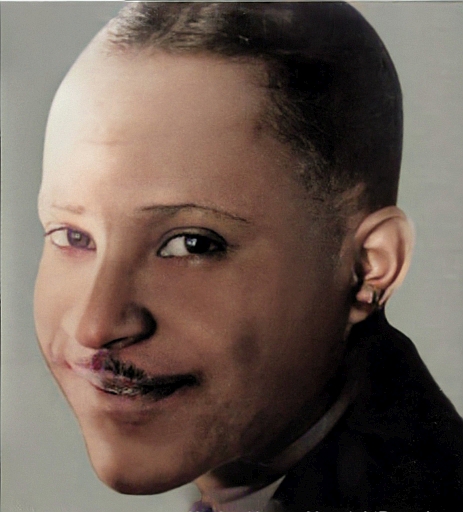
His aunt, Florence Howard, remembered him fondly as a tall, light-skinned, handsome man and shared photos and stories with researchers in the 1960s. Though he left no surviving solo 78 rpm recordings, Johnson’s legacy endures through hundreds of piano rolls and blues accompaniments — his style blending elegance, clarity, and deep blues feeling in a way that few others matched.
